How we serve it
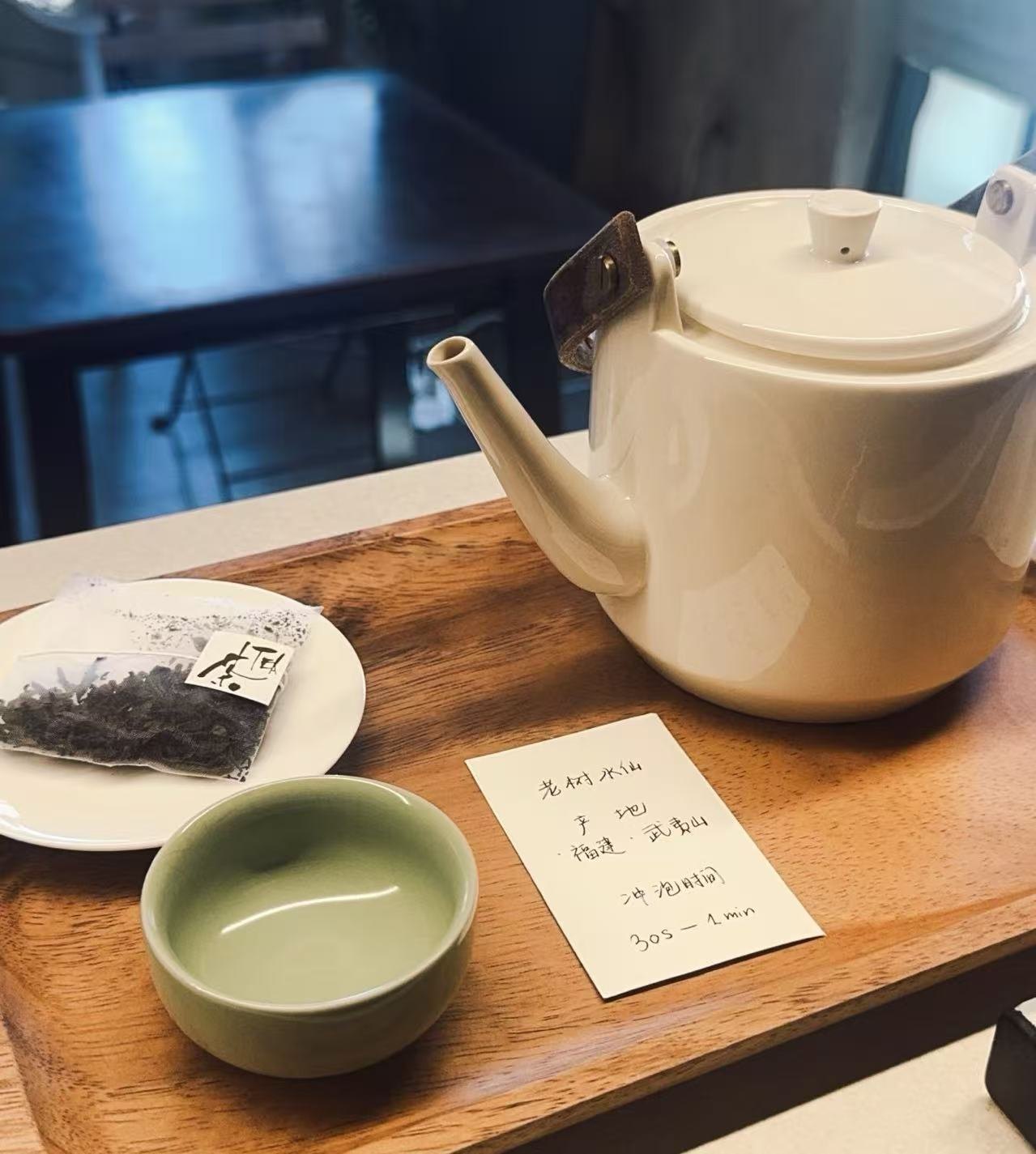
We only use whole-leaf tea: sometimes loose, sometimes in a filter — but even in the filter you'll find whole leaves, not dust. The photo above shows the Shui Xian: a teapot, a small cup and a handwritten card with the tea's name, its origin (Wuyishan, Fujian) and the suggested steeping time, 30 seconds to one minute. When the pot runs low, just ask us to top up the hot water: in Chinese tradition the same leaves are infused several times, and the taste shifts a little from cup to cup. That's why one tea can keep you company through an afternoon of work or study.
Our five teas
Zheng Shan Xiao Zhong 正山小种 — a black tea from the Wuyi Mountains in Fujian (in Chinese it's called "red tea", 红茶). Tradition counts it among the first black teas in history, and it's the tea that became famous in the West as Lapsang Souchong: it was once dried over pinewood smoke, though unsmoked versions exist today. Ours is smooth and naturally sweet, with honey notes and an aroma of dried fruit.
Tie Guan Yin 铁观音 — one of China's most famous oolongs, from Anxi County in Fujian. The partly oxidised leaves are rolled into small balls that unfurl in the water. It comes in a lighter, floral style and a roasted one: ours has an orchid aroma, a floral, fresh taste and a silky texture.
Phoenix Dan Cong 凤凰单丛 — an oolong from Fenghuang ("Phoenix") Mountain near Chaozhou, in Guangdong. Dan cong means "single bush": it originally meant the leaves of one plant, picked and processed separately; today the name also covers the local cultivars. It's known for naturally floral and fruity aromas: ours has floral notes, a honey-like sweetness and a complex aroma.
Long Jing ming qian 明前龙井 — "Dragon Well", a green tea from the West Lake area of Hangzhou, in Zhejiang. The leaves are pan-fired, which stops oxidation and gives them their characteristic flat shape. Ming qian means "before Qingming": it's picked before this period of the Chinese calendar, which falls on 4, 5 or 6 April, from the first spring leaves. Elegant aroma, sweet and delicate taste, very smooth.
Lao Cong Shui Xian 老枞水仙 — new on our menu. It's an oolong from the Wuyi Mountains in Fujian, one of the area's so-called "rock teas" (yan cha). Shui Xian (水仙, "narcissus") is the name of the tea-plant variety; lao cong means "old bush", i.e. leaves picked from old tea plants. In China people speak of its cong wei, the "old-bush taste": woody, mossy and bamboo-leaf notes in an amber-coloured cup.
Hot or iced
Many of our teas can also be ordered iced — just ask at the counter. But it's now, with the first cool days, that hot tea is at its best.
Which one to choose
If you like soft, sweet flavours, the Zheng Shan Xiao Zhong. If you want something floral, the Tie Guan Yin. If you want a very aromatic tea, the Dan Cong. If you prefer delicacy, the Long Jing. If you like deep, woody flavours, the Lao Cong Shui Xian. Can't decide? Just ask at the counter. A slice of our French pastry always goes well alongside.
Where we are
FYSA is at Piazza di Ponte Lungo 1, Rome — San Giovanni / Appio Latino, on the border with Tuscolano. From Metro A, take the "Piazza Ponte Lungo" exit: we're right there, a 1-minute walk. Open every day from 9:00 to 19:00. If you're staying nearby, Metro A runs straight to San Giovanni, Termini and Spagna. Find us on Instagram at @fysa_cafe.